 Intercom Fin
Is Intercom Fin worth it?
Intercom Fin is worth it when the help center is clean, Procedures cover the actions you actually need, and you accept that a successful bot raises a usage bill rather than only a seat bill. It is not a standalone omnichannel platform you drop onto a site with no inbox strategy. All current Intercom plans include Fin access. You are not billed for Fin if you do not use it. When you do use it, chat and email outcomes are $0.99 each, once per conversation. Qualification outcomes for Fin for Sales are $9.99.
Best for teams that will live in Intercom. The 14-day trial includes Fin and the add-ons, with no credit card required. After that, budget seats, outcomes, and any Copilot, Pro, or Proactive Support Plus lines. Fin Voice, high-volume discounts, and Fin on a non-Intercom helpdesk go through sales. Confirm the live mix on intercom.com/pricing and the outcomes help article.
How we evaluated this
We evaluated Fin as a billing model and an operating loop. Scoring weights outcome definition (paid, refunded, free), the seat stack, Procedure depth, channel truth (Messenger and email versus usage-based WhatsApp, SMS, Phone), and controls (simulations, escalation rules, hard limits). Tests: reopen refunds, assumed resolution on a silent walkaway, a billable Procedure handoff versus a free “agent please,” and standalone Fin on Salesforce. Official sources were rechecked August 19, 2026.
Pricing calculation to run
Fin’s $0.99 is not the bill. Seats plus outcomes plus assumed resolutions are.
Intercom’s public story is simple: Fin is $0.99 per outcome, charged at most once per conversation. That unit is real. It is also not how the invoice looks. Most teams still pay for full Intercom seats so humans can take the conversations Fin does not finish. Copilot, WhatsApp, SMS, Phone, and Proactive Support Plus sit beside that. The original cost mistake is comparing Fin’s $0.99 to a rival’s per-resolution fee without putting seat cost in the same cell.
- Price the inbox first. Annual full seats are $29 Essential, $85 Advanced, $132 Expert per seat per month. Monthly is $39 / $99 / $139. Advanced includes 20 Lite seats. Expert includes 50. Lite seats cannot send customer messages.
- Layer Fin at $0.99 per resolution, Procedure handoff, or disqualification. Fin for Sales qualifications are $9.99. You are not charged when the customer asks for a human, a Procedure fails, or Fin escalates on workspace rules.
- Watch assumed resolutions. If Fin answers and the customer leaves without asking for more help, Intercom counts that as a resolution and bills $0.99. A later reopen in the same conversation refunds it. A new conversation does not.
- Set hard limits before a launch. Intercom documents usage reminders and caps. A bot that “works” on day one is how finance discovers outcomes in week two.
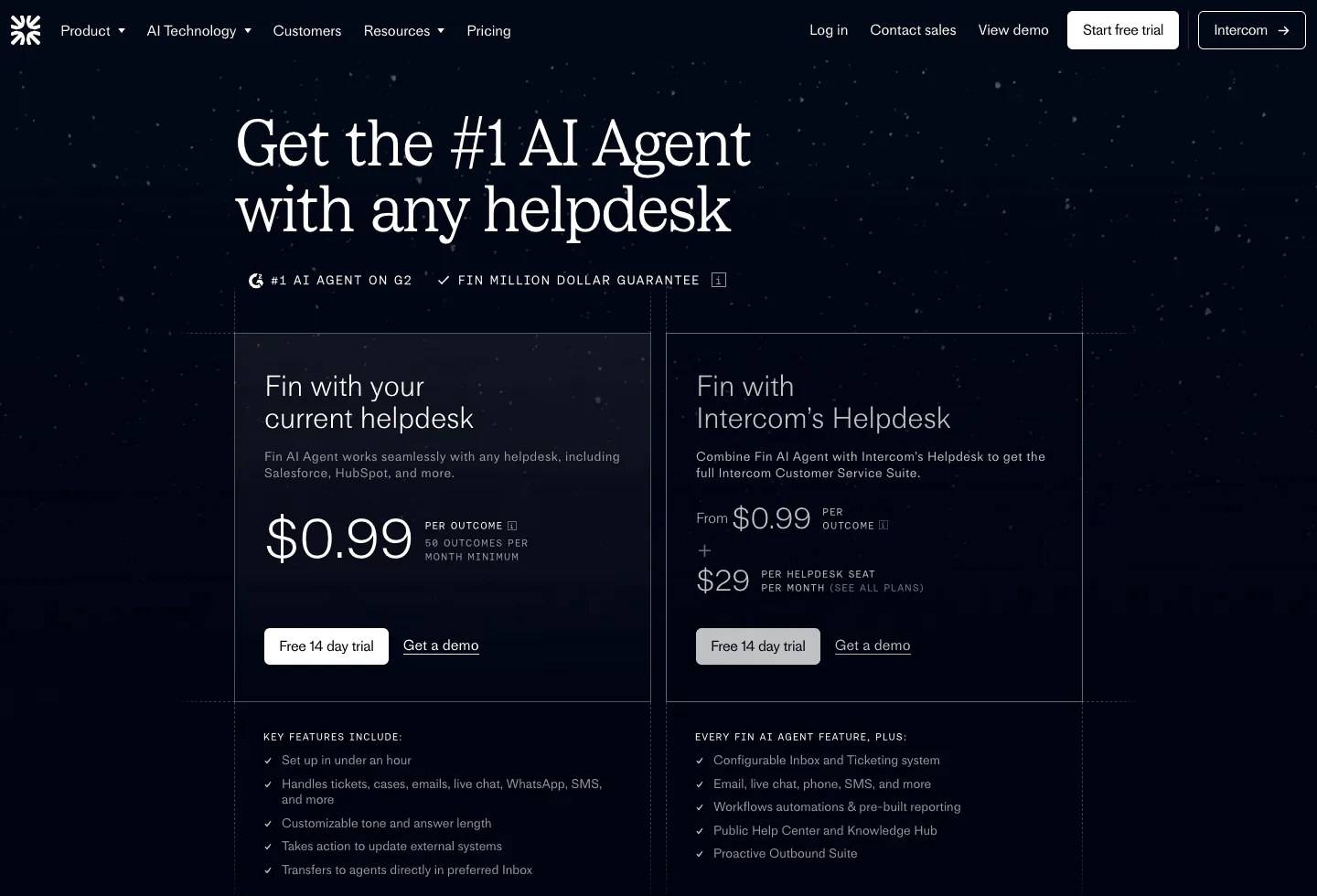
- If you do not want Intercom seats, the standalone Fin path is $0.99 per outcome with a minimum commitment (the pricing FAQ’s example is 50 outcomes, about $49 per month), no seats, sales-led. You still need an inbox for the humans.
Worked example: 10 full Advanced seats billed annually ($850 per month) and 2,000 inbound conversations. At a 60% Fin resolution rate you bill 1,200 outcomes, or $1,188. Combined software is about $2,038 before Copilot, WhatsApp, or Phone. At 35% resolution you bill $693 in outcomes, but you still need the $850 seat block unless you actually cut headcount. Outcome spend fell. The seat spend did not.
Now add Copilot. Unlimited Copilot is $29 per agent per month billed annually ($35 monthly). Ten agents add $290. Every full seat already includes 10 Copilot and 10 auto-translation conversations per month. If agents only need light assist, skip the add-on and count the included 10. If they live in Copilot all day, the add-on is the real “AI for humans” line, separate from Fin’s $0.99.
Assumed-resolution variant: of those 1,200 billed outcomes, suppose 200 are customers who got a wrong answer and left. You paid $198 for conversations that will bounce to email or a one-star review. Intercom will not charge a default frustration escalation, so configure that rule. Paying $0.99 for silence is the hidden meter. Your pilot should split confirmed resolution, assumed resolution, Procedure handoff, unreopened 48-hour repeat contact, and CSAT on Fin-closed conversations. If assumed is a large share, you are buying a quiet failure, not a resolution.
Qualification trap: Fin for Sales qualifications are $9.99. Ten demo bookings are $99.90. Two hundred “routed to self-serve onboarding” events that still count as qualifications are $1,998. Keep sales outcomes in a separate budget tab.
Who Intercom Fin fits best
Strengths
- True outcome billing on chat and email: you pay when Fin resolves, completes a configured Procedure handoff, or (for sales) qualifies or disqualifies. Failed attempts and “customer asked for a human” are free.
- One conversation, one charge: multiple questions and multiple Procedures in the same thread still bill once.
- Reopen refund: if a counted resolution is later continued in the same conversation, Intercom deducts the charge. That is more buyer-friendly than most resolution meters.
- Procedures: Fin can collect context, call systems, and hand off on purpose. That handoff is billable, which is honest if you designed it.
- Help center plus inbox training: Fin is built to sit on Intercom content, attributes, and conversation history rather than a disconnected PDF dump.
- Standalone option: Fin can run on Salesforce and other helpdesks without Intercom seats. Useful if the inbox is already frozen and you only want the agent layer.
- Security depth: SOC 2 Type II, ISO 27001, ISO 27701, ISO 42001, AIUC-1 for Fin, HIPAA on Expert, data residency in US, EU, or AU, 99.8% uptime SLA.
Limitations to verify
- Fin on Intercom is not “Fin instead of Intercom.” Humans still need full seats. Lite seats do not replace them.
- Assumed resolutions can bill silence. You must configure frustration and low-confidence escalations or you will pay for walkaways.
- WhatsApp, SMS, Phone, and email campaigns are usage-based. Inbound support email is included. Outbound is not a free channel.
- SLAs, HIPAA, SSO, and multibrand Messenger sit on Expert. Do not buy Essential and assume those controls appear.
- Fin Voice is sales-quoted. Do not copy the $0.99 chat rate onto phone.
- Fin for other helpdesks cannot currently use Fin for Sales or Fin for Ecommerce. Those need an Intercom plan.
- Custom Answers on current plans are billed as outcomes. Legacy assumptions about “canned answers are free” are wrong on the new plans.
Channel coverage to verify
Fin’s $0.99 documentation applies to chat and email with Intercom. Everything else is either included Messenger surface, a usage-based channel, or sales-quoted Voice. Demo the channel you will actually staff.
- Intercom Messenger on web and in-app, including logged-in user attributes.
- Email in the shared inbox. Inbound support email is included. Bulk email campaigns are usage-based.
- Help center search and conversational answers from public (all plans) or private and multilingual help centers (Advanced and Expert).
- WhatsApp, billed per conversation, volume and direction dependent. Not a free Fin surface.
- SMS, billed per message, region dependent.
- Phone and Fin Voice: contact sales. Do not assume chat outcome pricing.
- Fin on Salesforce or another helpdesk: Fin answers in that inbox and hands off there. You lose Intercom-only sales and ecommerce Fin features unless you also run an Intercom plan.
Workflow execution and handoff
Fin should do three jobs: answer from your knowledge, run a Procedure when the question is an action, and hand off with context when the question is a person. The operating risk is mixing those jobs. If every “I want a refund” is a free-text answer instead of a Procedure with a cap, you will either hallucinate policy or create assumed resolutions when the customer gives up.
Handoff types are not equal in billing. A Procedure you designed to end in @handoff is a $0.99 outcome. A customer who types “agent please,” or a workspace escalation rule, is not billed. Train your team on that difference. Otherwise people will write Procedures that always hand off, and you will pay $0.99 as a routing fee on top of the human handle time.
- Deflect article-shaped questions with source-grounded answers and a visible path to a human.
- Collect order ID, account, or plan before Fin guesses. If Fin’s last message is a clarifying question and the user goes silent, Intercom does not count a resolution. That is the right default. Do not “fix” it by having Fin send a fake answer so the conversation bills.
- Procedure for password reset, plan change, or Shopify lookup, with a documented failure path that is not billable if the Procedure errors.
- Sales qualification only after legal and finance agree that $9.99 per routed prospect is acceptable.
Pricing checked August 19, 2026
Intercom Fin pricing: $0.99 outcomes on top of $29-$132 seats
Intercom’s current public plans are Essential, Advanced, and Expert. Every plan includes Fin AI Agent, Messenger, a shared inbox, ticketing, pre-built reports, and a public help center. Unlimited live chat, support email, in-app chats, banners, and tooltips are included. Fin, email campaigns, SMS, WhatsApp, and Phone are usage-based. Figures below are from intercom.com/pricing and the plans explained article, checked August 19, 2026.
| Plan | Public price | Included capacity / meter | Best fit |
|---|---|---|---|
| Essential | $29/seat/mo annual, $39/seat/mo monthly | Fin at $0.99 per outcome. 1 full seat minimum. No Lite seats. Public help center, shared inbox, pre-built reports. No workflows builder, no private help center. | Small teams that will live in one inbox and can accept simple automations |
| Advanced | $85/seat/mo annual, $99/seat/mo monthly | Everything in Essential, plus workflows, multiple team inboxes, round robin, private and multilingual help center, custom reports, Salesforce integration. 20 Lite seats included. | Growing support orgs that need assignment and a workflow builder |
| Expert | $132/seat/mo annual, $139/seat/mo monthly | Everything in Advanced, plus SSO, HIPAA, SLAs, multibrand Messenger and help center, workload management, real-time dashboard, extended API. 50 Lite seats included. | Multi-brand or regulated teams that need SLAs and identity controls |
| Fin AI Agent (standalone) | $0.99 per outcome | No Intercom seats. Minimum monthly commitment (public example: 50 outcomes). No setup or platform fee in the public FAQ. Sales-led. Chat and email only at this rate. Voice quoted separately. Fin for Sales and Fin for Ecommerce not included. | Teams that will keep Salesforce, HubSpot, or Freshdesk as the inbox |
| Fin outcomes (on Intercom) | $0.99 resolution, Procedure handoff, or disqualification. $9.99 sales qualification | Once per conversation. Not billed if unused. Reopen in the same conversation refunds a resolution. Hard limits available. | Any plan that actually turns Fin on |
Sources: Intercom official pricing page, Fin and Intercom plans explained, and Fin AI Agent outcomes. Confirm live seat prices, Fin Voice, high-volume outcome rates, and standalone minimums with sales if you are not self-serve.
Add-ons checked August 19, 2026
Copilot, Pro, and Proactive Support Plus
| Add-on | Public price | Included capacity / meter | Best fit |
|---|---|---|---|
| Copilot | $29/agent/mo annual, $35/agent/mo monthly | Unlimited Copilot usage as an add-on. Without it, each full seat includes 10 Copilot and 10 AI auto-translation conversations per month. | Agents who draft all day in the inbox |
| Pro | $99/mo | Analysis of 1,000 conversations per month, 2,000 credits per month, Operator for customer operations. Extra credits $0.01 each. Credit use scales with conversation volume. | Teams that will QA Fin and mine conversation trends |
| Proactive Support Plus | $99/mo | 500 messages included. Product Tours, Surveys, in-app messages, mobile push, carousels, Series. Extra messages billed per unit. | Product-led outbound inside Intercom, not a support-only shop |
Source: Intercom pricing FAQs on the same pricing page. Startups can apply for Early Stage (up to 93% off plus one year of Fin free). 14-day trial includes Fin and add-ons.
AI capability, Procedures, and outcome quality
Fin answers from your help center, Fin content, and connected data, then can run Procedures that call external systems. Intercom’s security page describes a Fin CX model stack (including Fin Apex 1.0) grounded in your knowledge, with third-party providers contractually barred from training on your data and zero retention after a response. You can opt out of Intercom’s own fine-tuning. Data from that path is deleted within 30 days of opt-out. Ask for that setting in writing if legal cares.
Hallucination control is operational: Fin can escalate below a confidence threshold, and Simulations exist for edge cases. None of that helps if articles contradict each other. Clean the source of truth first.
- Resolution quality: confirmed (“thanks, that worked”) versus assumed (silence after an answer). Optimize for confirmed plus low 48-hour repeat contact, not for raw resolution rate.
- Procedure success: the action completed, or the Procedure failed (not billed) and a human saw why.
- Guidance versus workspace rules: Procedure-specific @handoff is billed. Global escalation rules are not. Put refunds and legal in global rules if you do not want to pay for the route.
- Custom Answers on current plans bill as outcomes. Do not build a library of “free” snippets and expect them to be unmetered.
- Spam routed to the Spam view is not an outcome. Abandoned conversations where Fin never answered are not outcomes.
Feature areas to verify
- Fin AI Agent on Messenger and email, with tone and answer-length controls.
- Procedures, including @handoff to a team, teammate, or workflow, and failure behavior.
- Help center as a source, including private and multilingual on Advanced and Expert.
- User attributes, custom objects, and past conversations in answers.
- Copilot drafts and the included 10-conversation cap versus the unlimited add-on.
- Usage dashboard: reminders, hard limits, outcome type breakdown.
- Simulations for edge cases before go-live.
- Standalone Fin on your current helpdesk, if that is the path, including what Fin for Sales and Ecommerce will not do.
- SSO, HIPAA, SLAs, and multibrand on Expert, if those are requirements rather than nice-to-haves.
- WhatsApp, SMS, and Phone rate cards for your volume and regions.
Analytics and operating visibility
Fin’s useful numbers are outcome type, resolution rate, assumed versus confirmed, reopen refunds, Procedure failures, and CSAT on Fin-closed conversations. Pre-built reports exist on every plan. Custom reports start at Advanced. A real-time dashboard is Expert. If you are on Essential, do not expect to build a warehouse-grade outcomes cube without exporting elsewhere.
Ask Intercom to show the exact fields that land on the invoice: outcome type, conversation ID, whether a reopen reversed a charge, and whether a teammate join still billed because Fin had already answered. If that report cannot be scheduled to finance, someone on your team will spend a day each month reconstructing it. Also separate Fin resolution rate from “handed to a human who then solved it.” Mixing those two is how deflection slides get written.
Security, data handling, and compliance
Intercom’s security page and Trust Center list SOC 2 Type II, ISO 27001, ISO 27018, ISO 27701, ISO 42001, AIUC-1 for Fin, GDPR, CCPA, and HIPAA (plan-dependent, Expert in the plans table). Data can live in the US, EU, or Australia. Uptime SLA is 99.8% across AI Agent and the core platform. SSO is documented with Okta, Azure AD, and OneLogin, plus 2FA, SCIM, and IP restrictions.
- Decide opt-out of fine-tuning before the trial ends, if that is a legal requirement. Deletion is documented as within 30 days of opt-out.
- Expert is the public plan that lists HIPAA and SSO. Do not assume Essential covers a BAA.
- Run Simulations on regulated content before Fin talks to customers.
- Third-party model providers: Intercom says zero retention after generation and no training on your data. Keep that language in the DPA review.
- Residency: pick US, EU, or AU on purpose. Do not discover it after you have transcripts in the wrong region.
What questions should you ask before buying Intercom Fin?
- For our volume, what is the seat plan, seat count, and Fin outcome estimate on the official calculator?
- How many of our last 50 conversations would have been confirmed resolutions versus assumed versus unbilled escalations?
- Show a Procedure that refunds, and a Procedure failure that does not bill.
- If a customer reopens after 26 hours, is that a refund or a new conversation?
- What is the Fin Voice price, and is it in scope?
- Do we need Copilot unlimited, or do 10 included conversations per agent cover us?
- If we run Fin on Salesforce, what minimum commitment applies, and which Fin products we lose?
- Where are usage hard limits set, and who gets the alert?
- Will our data be used for Intercom fine-tuning, and how do we opt out?
- Which plan actually includes SLAs, SSO, and HIPAA for our industry?
What red flags should you watch for with Intercom Fin?
- The pilot quotes $0.99 and never shows seat, Copilot, or WhatsApp lines.
- Assumed resolutions are celebrated as “high resolution rate” with no CSAT split.
- Procedures always @handoff, so you pay $0.99 as a router plus human time.
- Fin for Sales is on, and nobody owns the $9.99 qualification budget.
- You need SLAs or HIPAA and you are being sold Essential or Advanced.
- Voice is in the RFP and the quote still uses chat outcome rates.
- Standalone Fin is sold as “no Intercom needed,” but your humans have no inbox and Fin for Ecommerce is required.
- No hard limit is configured, and launch week is a product-hunt spike.
What are the best alternatives to Intercom Fin?
Choose based on the inbox you will staff and the meter you can live with. Intercom Fin is not an alternative to itself.
- Zendesk AIChoose Zendesk AI when ticket taxonomy, SLA clocks, sandbox, and Copilot-as-agent-assist matter more than Messenger-first outcome billing.
- YourGPT AIChoose YourGPT when you need omnichannel messaging without committing the workspace to Intercom.
- GorgiasChoose Gorgias when Shopify order context and ticket-based ecommerce support are the job, not a help-center agent in Messenger.
- ChatbaseChoose Chatbase when you want a website-trained agent on message credits, without Intercom seats.
- TidioChoose Tidio when a small team wants live chat plus Lyro at a lower entry price and can accept separate conversation meters.
Workflow test
What Fin needs to prove in your inbox
- Ground the answer.Ask a policy question that is in your help center and one that is not. Fin should cite the article or escalate, not invent a middle path.
- Run a Procedure.Look up an account or order and complete or fail the action in a sandbox. Confirm billing: success is $0.99, technical failure is not.
- Trigger both handoff types.One customer asks for a human (should not bill). One Procedure @handoff (should bill once). Read the outcome type on the usage dashboard.
- Reopen and silence.Close an assumed resolution, then reopen the same conversation (charge should reverse). Leave after a wrong answer with frustration rules off, then on, and compare billing.
Related reading
Related Reading
Official sources to verify
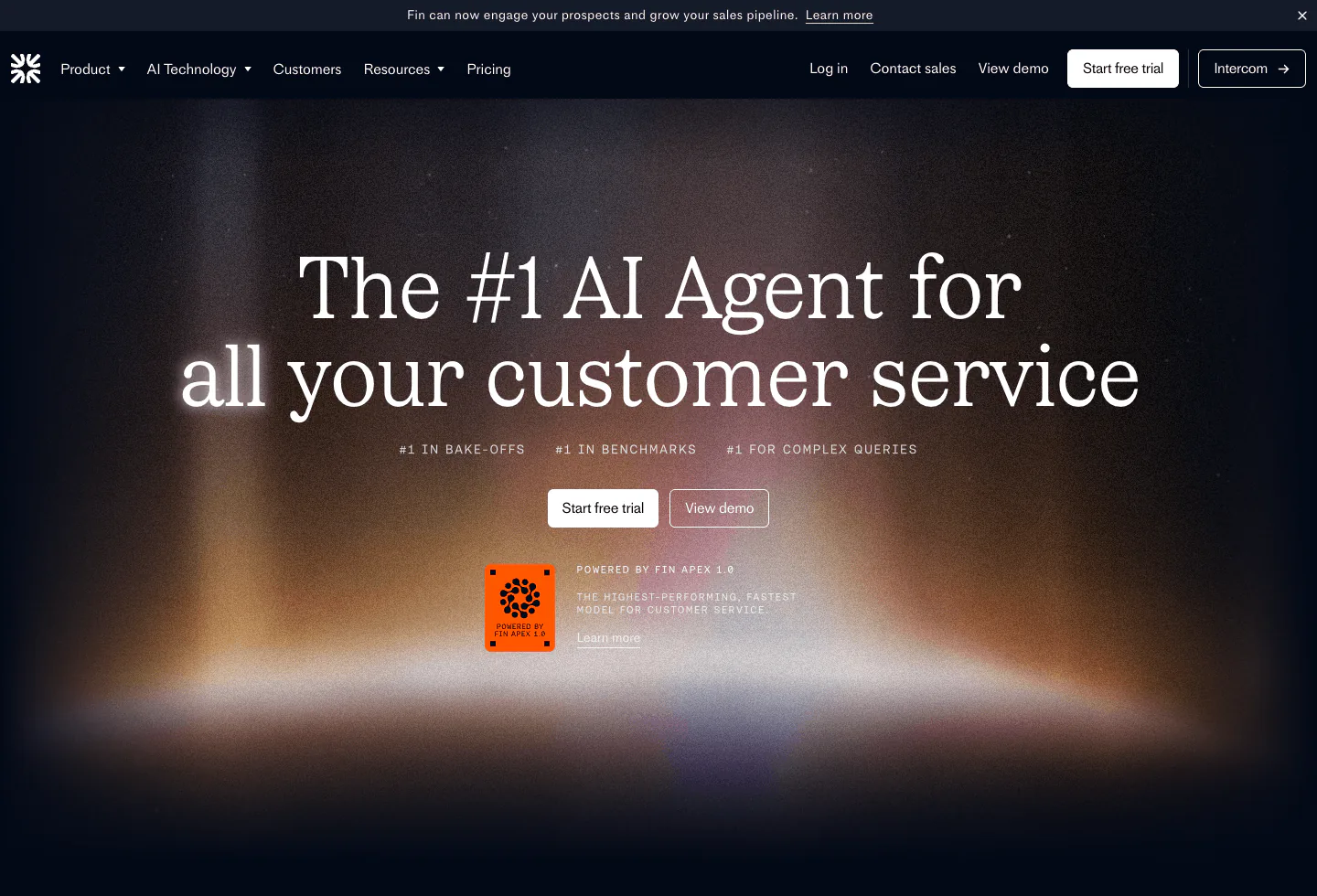 Official Intercom Fin product page
Source snapshot 2026-08-19 - intercom.com
Fin AI Agent positioning, channels, and helpdesk-agnostic path.
Official Intercom Fin product page
Source snapshot 2026-08-19 - intercom.com
Fin AI Agent positioning, channels, and helpdesk-agnostic path.
 Official Intercom pricing page
Source snapshot 2026-08-19 - intercom.com
Essential, Advanced, Expert, $0.99 Fin outcomes, Copilot, Pro, and Proactive Support Plus.
Official Fin AI Agent outcomes article
Source snapshot 2026-08-19 - intercom.com
Resolution, Procedure handoff, qualification at $9.99, assumed resolution, and reopen refunds.
Official Intercom security page
Source snapshot 2026-08-19 - intercom.com
SOC 2 Type II, ISO stack, AIUC-1, residency, and fine-tuning opt-out.
Official Intercom pricing page
Source snapshot 2026-08-19 - intercom.com
Essential, Advanced, Expert, $0.99 Fin outcomes, Copilot, Pro, and Proactive Support Plus.
Official Fin AI Agent outcomes article
Source snapshot 2026-08-19 - intercom.com
Resolution, Procedure handoff, qualification at $9.99, assumed resolution, and reopen refunds.
Official Intercom security page
Source snapshot 2026-08-19 - intercom.com
SOC 2 Type II, ISO stack, AIUC-1, residency, and fine-tuning opt-out.
Claim and source ledger
What this profile is based on
Public Intercom Fin product page, Intercom pricing page, “Fin and Intercom plans explained,” “Fin AI Agent outcomes,” and the security page, rechecked August 19, 2026. Seat prices ($29/$85/$132 annual, $39/$99/$139 monthly), Fin at $0.99, qualification at $9.99, Copilot at $29/$35, Pro at $99, Proactive Support Plus at $99 with 500 messages, and standalone Fin with a minimum commitment are taken from those official documents. Existing screenshots in /images/sources/ are reused.
What we did not verify
We did not measure Fin resolution rate on a labeled set, audit assumed-resolution quality, or review DPA and SOC 2 reports under NDA. Fin Voice and high-volume outcome discounts are sales-quoted. Standalone Fin minimums are described as “e.g. 50 outcomes” in public FAQs. Confirm the contractual minimum. We did not independently verify AIUC-1 or ISO certificates beyond the public security page.
How we scored fit
Editorial fit weights the honesty of outcome billing (including assumed resolutions), the need for Intercom seats beside Fin, Procedure versus default escalation, and whether a team can operate hard limits. It is not a resolution-rate benchmark or a CSAT score.
Should you choose Intercom Fin?
Choose Intercom Fin when support will live in Intercom, your help center can ground answers, and you are willing to model $0.99 outcomes on top of full seats. The reopen refund and “failed attempts are free” rules are better than many rivals. Assumed resolutions and $9.99 qualifications are how the same rules go wrong.
Best for Intercom-native support orgs that will set escalation rules and usage caps before launch. Choose Zendesk AI if governance is the job, Gorgias if Shopify tickets are the job, and Chatbase or Tidio if you are not buying an inbox suite. If the only number in the deck is $0.99, the deck is incomplete.
FAQ
Common questions
What is Intercom Fin best used for?
As the AI agent on Intercom Messenger and email, trained on your help center and Procedures, with humans on exceptions. It can also sit on Salesforce or another helpdesk as a sales-led add-on without Intercom seats.
Does Fin work without Intercom?
Yes, standalone on supported helpdesks at $0.99 per outcome with a monthly minimum and no Intercom seats. Sales-led. Fin for Sales and Fin for Ecommerce currently need an Intercom plan. Humans still need an inbox.
How does Intercom Fin pricing work?
Seats at $29/$85/$132 per month annual ($39/$99/$139 monthly) on Essential, Advanced, Expert. Fin outcomes $0.99 on chat and email (qualifications $9.99), once per conversation, only when Fin succeeds. Copilot, Pro, Proactive Support Plus, WhatsApp, SMS, and Phone are extra.
What counts as a billable Fin outcome?
A resolution (confirmed or assumed), a configured Procedure handoff, or a sales qualify/disqualify. Not billed: customer asks for a human, workspace escalation rules, Procedure failure, spam, or abandonments where Fin never answered.
Do assumed resolutions cost money?
Yes. If Fin answers and the customer does not ask for more help, Intercom bills $0.99. A later continue on the same conversation deducts the charge. Configure frustration escalations if you do not want to pay for walkaways.
How much is Copilot?
$29 per agent per month annual, or $35 monthly, for unlimited usage. Each full seat already includes 10 Copilot and 10 auto-translation conversations per month.
Intercom Fin vs Zendesk AI?
Fin for messaging-first support and published outcome billing. Zendesk AI for ticket taxonomy, SLA clocks, and sandbox. Copilot exists in both and is not the autonomous-agent meter.
Is Intercom Fin secure?
Public claims include SOC 2 Type II, ISO 27001/27701/42001, AIUC-1, GDPR, CCPA, optional HIPAA on Expert, and US/EU/AU residency. Request Trust Center artifacts and decide on fine-tuning opt-out before production.
Who should skip Fin?
Skip it if you will not staff Intercom or another connected desk, cannot define outcomes, need Voice at $0.99 with no quote, or only need a cheap website bot. Do not turn Fin on without hard limits.
How long does setup take?
Intercom advertises Fin on an existing helpdesk in under an hour. A production workspace with a clean help center and Procedures takes days to weeks. The 14-day trial tests outcome types. It does not rebuild knowledge.
Also review