 Gorgias
Is Gorgias worth it?
Gorgias is worth it for ecommerce support teams that need order, shipping, and customer data inside every ticket, plus an AI Agent that can close repetitive WISMO and return conversations without a human. It is not a horizontal AI agent for SaaS, internal ops, or enterprise IT. The public helpdesk starts at $10 per month for 50 tickets on Starter and steps through Basic at $60, Pro at $360, and Advanced at $900 on monthly billing, with annual contracts advertised at up to 17% off except Starter. AI Agent is a second meter: you pay when the bot fully resolves a conversation.
Best for Shopify-centric DTC brands that already measure support by ticket volume and revenue recovered in chat. It is a poor fit when you need skills-based routing, custom SLA clocks, or a bot that lives on a website without a store backend. Confirm the live card on the official Gorgias pricing page because the Helpdesk plus AI Agent packaging has shifted during 2026.
How we evaluated this
We evaluated Gorgias as a commerce operations platform. Scoring weights store context in the ticket, safe Actions inside policy, honest ticket-plus-AI math at peak, channel coverage, and governance (roles, audit, SSO). Trial tests: a live Shopify order in the ticket, a return under and over your dollar cap, a handoff with transcript plus order plus reason, and a November model that does not guess the overage rate. Official sources were rechecked August 19, 2026.
Pricing calculation to run
Stack helpdesk tickets and AI resolutions. Peak month is the real price.
Gorgias looks cheap next to seat-based suites because Starter is $10 and Pro is $360 with unlimited agents. That comparison is incomplete. You run two meters. Helpdesk tickets cover human-handled conversations. AI Agent covers conversations the bot closes end to end. Fully automated interactions do not count as helpdesk tickets, which is the whole point. They still show up as AI interactions, and overage rates on those interactions are higher than the included rate.
- Count last-90-day tickets by type: WISMO, return or exchange, product question, pre-purchase, VIP, angry, and “needs a human.” Only the first two buckets are reliable AI volume.
- Price the helpdesk plan on the human remainder, not on total inbound. If AI takes 40% of 2,000 tickets, you are buying capacity for 1,200 human tickets plus 800 AI interactions, not for 2,000 of either.
- Apply the official AI rate from the Gorgias AI Agent pricing explainer: most plans $0.90 per resolved interaction, Starter $1.00. Included allowances run from about 90 to 2,500-plus per month.
- Use the higher overage for the peak month: Support plus Shopping Assistant is $1.50 per extra interaction. Support-only is $1.00-$2.00 monthly and $0.83-$1.67 annual. Voice starts at $70 per month plus usage and also creates tickets.
Worked example for a Shopify brand at 2,000 tickets in a normal month and 4,000 in November. Assume 40% of volume is automatable WISMO and returns, and you sit on Pro ($360 per month, 2,000 tickets, $0.25 human overage) with an AI allowance of 800 interactions at $0.90.
Normal month: 800 AI resolutions cost $720. The remaining 1,200 human tickets fit inside Pro. Combined software cost is about $1,080 before Voice, SMS, or apps. That is three times the Pro sticker.
November: 1,600 AI resolutions and 2,400 human tickets. Human overage is 400 × $0.25 = $100. AI overage at the Shopping Assistant rate is 800 × $1.50 = $1,200. Combined software is about $2,380 for one peak month, before telephony. Size the AI allowance to the spike if that is cheaper than living on overage. The mistake is treating $360 as the cost of “Gorgias plus AI.”
A second trap: the May 14, 2026 plan guide still says AI Agent “starts at $250 monthly,” while the May 28 article and the live pricing page describe per-interaction allotments. Ask sales to export helpdesk tier, AI allotment, overage, and Shopping Assistant flag. Do not freeze either blog number into a contract.
Who Gorgias fits best
Strengths
- Store-native inbox: Shopify, BigCommerce, Magento, and WooCommerce context (order, tracking, customer tags, SKU) lives on the ticket instead of in a browser tab.
- Ticket pricing, not seat pricing: Pro and Advanced advertise unlimited agent seats. Growing a 12-person seasonal team does not 12x the software line the way Zendesk seats do.
- AI that can act, not only answer: Official AI Agent docs list cancellations, returns, subscription edits, vision on damaged-item photos, and multi-language replies.
- Social and ads in the same queue: Facebook, Instagram, X, and ad comments matter for DTC brands that get volume from paid social.
- Revenue-aware reporting: Support conversations can be tied to sales, which is the argument you take to finance when asking for Pro.
- Fast store go-live: Gorgias claims most brands go live within 48 hours on Shopify. Vendor claim, fair for a single store with clean macros.
Limitations to verify
- Non-retail and B2B SaaS teams get little from order macros and Shopping Assistant. Buy a horizontal agent or a governed helpdesk instead.
- Starter is 3 seats and 50 tickets. Basic still lists three seats in the May 2026 plan guide. Confirm before peak hiring.
- Voice and SMS are usage add-ons that also create tickets. SLA clocks and sandbox controls are weaker than Zendesk.
- AI accuracy is buyer-owned: guardrails, refund caps, and weekly sources. May 2026 AI packaging was described two ways, so get the rate card in writing.
Channel coverage to verify
Gorgias is an omnichannel ecommerce inbox, not a WhatsApp-first suite. Ask which channels are native on your target plan and which are billed as Voice or SMS add-ons. Test handoff quality per channel, because a clean email transcript does not prove a clean Instagram handoff.
- Email to a support address, including threaded replies and merged tickets after a customer writes twice.
- Live chat on the storefront, including Shopify theme embed, visitor path, and cart state.
- Facebook, Instagram, and X messages, plus ad comments and review replies that become tickets.
- SMS as an add-on. Pricing varies by country and volume. Customer-initiated texts count as billable tickets.
- Voice as an add-on from $70 per month plus usage on the plan guide. Confirm recording, voicemail-to-ticket, and AI coverage on voice before you promise phone automation.
- Help Center as self-service. The 7-day trial cannot publish a Help Center, so do not judge self-service from the trial alone.
- WhatsApp and other messaging apps: treat as “verify during demo.” Do not assume parity with YourGPT AI or dedicated WhatsApp suites.
Workflow execution and handoff
The workflow that matters is post-purchase. A WISMO ticket should already show the Shopify order, fulfillments, tracking URL, and customer value. A Rule or AI Action should send tracking or, if the parcel is delayed past policy, offer a return, store credit, or human queue. If the bot only paraphrases a shipping FAQ, you bought a chatbot. Handoff belongs in the unified inbox for refunds over a cap, chargebacks, safety claims, and VIP tags. Humans must see the bot’s attempted Action, not only the chat text.
- WISMO auto-reply using live tracking, not a static “allow 5-7 days” paragraph.
- Return and exchange flows that write back to Shopify (label, refund, restock) inside policy.
- Subscription edits (skip, swap, cancel) through a connected subscription app, with a human gate on retention offers.
- Macro libraries keyed to product, tag, or order value so agents are not rewriting the same return email.
- Shopping Assistant on the storefront for size, restock, and bundle questions, billed as AI interactions when it resolves without a human.
Pricing checked August 19, 2026
Gorgias pricing: $10 helpdesk starter, then tickets plus AI interactions
Gorgias publishes a ticket-based helpdesk ladder and a separate AI Agent meter. The official plan guide (updated May 14, 2026) lists Starter, Basic, Pro, Advanced, and Enterprise, with annual billing advertised at up to 17% off except Starter. The live page headlines Helpdesk plus AI Agent as one surface. Confirm in-account. Gorgias revised AI packaging during 2026.
| Plan | Public price | Included capacity / meter | Best fit |
|---|---|---|---|
| Starter | $10/momonthly. No annual discount listed. | 50 billable tickets. 3 agent seats. Overage $0.40 per extra ticket. AI Agent at $1.00 per resolved interaction on Starter. | New stores testing the inbox with very low volume |
| Basic | $60/moabout $600/year at the advertised 17% annual save | 300 billable tickets. Plan guide lists 3 agent seats. Email, live chat, Rules, Help Center. Overage $0.40 per extra ticket. | Growing Shopify brands with a small team and steady WISMO volume |
| Pro | $360/moabout $3,600/year at the advertised 17% annual save | 2,000 billable tickets. Unlimited agent seats. Advanced automation, custom Views, revenue statistics. Overage $0.25 per extra ticket. | Scaling DTC teams that would otherwise buy 8-plus Zendesk seats |
| Advanced | $900/moannual discount advertised up to 17% | 5,000 billable tickets. Unlimited seats. Overage described as custom. Premium support features on top of Pro. | High-volume brands before a custom Enterprise contract |
| Enterprise | Customannual contract | Custom ticket volume, Voice and SMS access, API depth, multi-brand setup. Seat policy is unlimited on the plan guide. | Multi-store, multi-region, or high-governance ecommerce orgs |
Sources: Gorgias official pricing page and Which Gorgias Plan Should You Choose? (updated May 14, 2026). Confirm live ticket allotments, seat counts on Basic, annual discount math, taxes, and overage terms before signing.
AI Agent and channel add-ons checked August 19, 2026
AI Agent, Voice, and SMS that change the real bill
AI Agent is not a flat “turn on chatbots” toggle. The AI Agent pricing article (updated May 28, 2026) prices fully automated, bot-closed conversations. Humans who take over are billed as ordinary helpdesk tickets, not as AI interactions. Spam, unreplyed email, and filtered messages do not count. You are not charged for both on the same conversation.
| Plan / add-on | Public price | Included capacity / meter | Best fit |
|---|---|---|---|
| AI Agent (most plans) | $0.90 per resolved interaction | Included monthly allotments from about 90 to 2,500-plus. Custom volumes for enterprise. You only pay when AI closes the conversation without a human. | Stores with repetitive tracking, return, and policy questions |
| AI Agent (Starter) | $1.00 per resolved interaction | Starter is the exception to the $0.90 headline. Keep this in the model if you test AI before upgrading the helpdesk. | Proof-of-concept on a tiny ticket load |
| AI overage, Support + Shopping Assistant | $1.50 per extra interaction | Same overage across paid tiers when Shopping Assistant is on the contract. This is the rate that bites in a sale week. | Brands running storefront Shopping Assistant plus support automation |
| AI overage, Support-only | $1.00-$2.00 monthly, $0.83-$1.67 annual | Varies by tier. Annual is cheaper per extra interaction. If you overage every month, upgrade the allotment instead of living on overage. | Support-only AI without Shopping Assistant |
| Voice | From $70/mo plus usage | Plan guide figure. Usage is extra. Customer-initiated calls become billable tickets. | Stores that still take phone for VIP or wholesale |
| SMS | Usage-based, varies by country | Add to any plan. Customer-initiated texts become billable tickets. Do not treat SMS as a free channel. | Order-update and two-way text programs |
Sources: Gorgias AI Agent Pricing, Explained (updated May 28, 2026) and the Voice and SMS section of the plan guide. The plan guide’s “AI Agent starts at $250 monthly” line conflicts with the later per-interaction article. Prefer the live pricing page and a written quote.
Other official notes: 7-day trial, no card required, max 10 email tickets, Help Center cannot be published in trial. Support tier follows revenue or contract size, not only plan name. App Store apps can add fees.
AI capability, actions, and what Gorgias can actually control
Gorgias AI Agent trains on Shopify data, the store site, Help Center, URLs, documents, and custom guidance. That is why it can answer a size-and-SKU question with inventory. It is also why a stale return article will be quoted with confidence. Official capabilities include tone instructions, Actions, language detection, vision on damaged-item photos, a test preview, and handover on low confidence, frustration, or human-only topics. Shopping Assistant is a related storefront product. If it is on the contract, remember the $1.50 overage rate.
- Order tracking, return starts, product Q&A, and policy answers are the intended AI diet. Put refunds above a cap, legal claims, and wholesale accounts on a forced human path.
- Actions that write to Shopify (cancel, refund, restock, subscription change) need an approval story. Ask who can raise the dollar cap, and whether that change is audited.
- Vision helps when a customer sends a photo of a crushed box. It does not replace a warehouse inspection policy. Test with your real damage photos, not a stock image.
- Multi-language replies are automatic by default. If your legal copy exists only in English, force a language or a handoff rather than letting the model translate policy on the fly.
- Hallucination still happens when sources conflict. Instruct source-only answers, cite the policy, and escalate on empty retrieval. Measure 48-hour repeat contact on AI-closed tickets. If that rate is high, you are paying $0.90 to create a second human ticket.
Ask for AI-handled CSAT versus human-handled CSAT on a 30-day sample of your own tickets. Automation rate can rise while CSAT on AI tickets falls.
Feature areas to verify
Use this list in a paid trial or demo with your store connected. A canned “demo store” hides connector lag, custom SKU logic, and the messy return policy you actually run.
- Unified inbox with Shopify, BigCommerce, Magento, or WooCommerce sync, including multi-store if you have more than one shop.
- Order, fulfillment, tracking, subscription, and customer tags visible without a browser extension.
- Rules and macros keyed to order value, SKU, tags, and channel.
- AI Agent Actions, guardrails, and a test bench that replays real tickets.
- Shopping Assistant on product pages, with a clear bill of AI interactions.
- Social and ad-comment capture, including assignment and public-reply permissions.
- Revenue statistics: which conversations attach to orders, and whether that export hits your warehouse or BI tool.
- Voice and SMS if they are in scope, including usage rates and ticket creation rules.
- App Store returns, loyalty, and subscription apps, plus roles so seasonal agents cannot issue unrestricted refunds.
Analytics and operating visibility
Gorgias reporting is built for a store lead: tickets by product and topic, first-response time by channel, agent performance, automation rate, CSAT, and revenue on conversations. Ask whether you can export AI-closed versus human-closed tickets with CSAT, and whether finance can match billable tickets plus AI interactions to the invoice and to Shopify order IDs. If that needs a CSM, budget a person for November reconciling.
Security, data handling, and compliance
Gorgias publishes a security page and a Trust Center. Public claims as of August 19, 2026 include SOC 2 Type II, HIPAA (report on request), SSO for Google and Microsoft 365, two-factor authentication, Google Cloud Platform hosting, encrypted backups, and HTTPS/TLS in transit. User roles and conversation history are first-class product controls: every agent can work from Gorgias instead of sharing the Shopify admin password, which is the actual security win for a store team.
- Request the current SOC 2 Type II report and, if needed, the HIPAA package before enabling refund Actions.
- Map roles so seasonal hires cannot export lists or raise refund caps. Review Shopify OAuth scopes: an AI that can cancel orders is an admin.
- Confirm whether conversations train shared models, and how long transcripts are kept after churn. The public bug bounty is paused; use the disclosure policy.
Keep full card numbers out of chat. If agents take cards today, fix that process before you turn on AI.
What questions should you ask before buying Gorgias?
- Show a live ticket on our Shopify store with order, tracking, and refund state, not a demo shop.
- Which helpdesk tier, ticket allotment, and overage rate apply at our last-90-day volume, and at 2x that volume?
- What AI interaction allotment, included rate, and overage rate apply if Shopping Assistant is on versus off?
- Which Actions can AI take on our store today (cancel, refund, exchange, subscription), and where is the dollar cap configured?
- How are assumed AI resolutions counted, and what happens if the customer writes back 12 hours later?
- How many agent seats are included on Basic right now, and is Pro still unlimited?
- What is the Voice monthly floor and per-minute rate for our region, and do calls create helpdesk tickets?
- Can we export AI versus human CSAT and invoice-matching usage, and who owns weekly source updates when policy changes?
What red flags should you watch for with Gorgias?
- The demo cannot connect your real Shopify catalog, or order data is hours stale.
- Pricing talk quotes only the helpdesk sticker and skips AI allotment, overage, Voice, and SMS.
- The vendor will not put the May 2026 AI packaging conflict into a written rate card (per-interaction versus “starts at $250”).
- AI is allowed to refund or cancel without a cap, audit trail, or human topic list.
- Nobody on your side owns the Help Center and product-page sources, so the bot will quote last season’s policy by week three.
- You need WhatsApp-first or enterprise SLA tooling and the demo waves at “coming soon” or a third-party app.
- Peak-season hiring depends on unlimited seats, but you are being sold Basic with a three-seat cap.
- Finance cannot reconcile billable tickets plus AI interactions to the invoice in a test month.
What are the best alternatives to Gorgias?
Pick the alternative based on where the work already lives. This is a decision list, not a ranking. Gorgias is not an alternative to itself.
- YourGPT AIChoose YourGPT when you need omnichannel agents across support, sales, and ops, including messaging channels that are not centered on a Shopify ticket.
- Intercom FinChoose Intercom Fin when the team already lives in Intercom (or will), and you want outcome-priced AI on top of a messaging inbox rather than a commerce helpdesk.
- Zendesk AIChoose Zendesk AI when SLA clocks, custom roles, sandbox, and auditability matter more than store-native macros and ticket-based seats.
- ChatbaseChoose Chatbase when you mainly need a website agent trained on help content, and store volume is too low to justify a commerce helpdesk.
- TidioChoose Tidio when a small store wants live chat plus Lyro at a lower entry price, and can live with separate conversation, Lyro, and Flows meters.
Workflow test
What Gorgias needs to prove on your store
A polished “where is my order” demo on a fake shop is not enough. Run this four-step test on a staging theme connected to a copy of real orders.
- Ground the answer in the order.Ask tracking, “is this deliverable to PO boxes,” and “can I change the address after fulfillment” on a live order. The reply must use that order’s state, not a generic shipping article.
- Take a write action inside policy.Start a return under your cap and refuse one over it. Confirm Shopify shows the refund or label, and that the refusal cites your rule.
- Force the guardrail.Send a chargeback threat, a medical claim, or a wholesale account number. The bot should hand off, not improvise a gesture.
- Hand off with store context.The human must see transcript, customer, order, attempted Action, and reason, without asking the shopper to paste an order number again.
Related reading
Related Reading
- Zendesk AI review for ticketing-first teams
- Intercom Fin review for outcome-priced support AI
- Tidio review for small-business live chat and Lyro
- How to choose an AI agent platform
- Customer support AI agents buyer guide
- Ecommerce AI agents for Shopify and returns
- Visit Gorgias - Official product page.
Official sources to verify
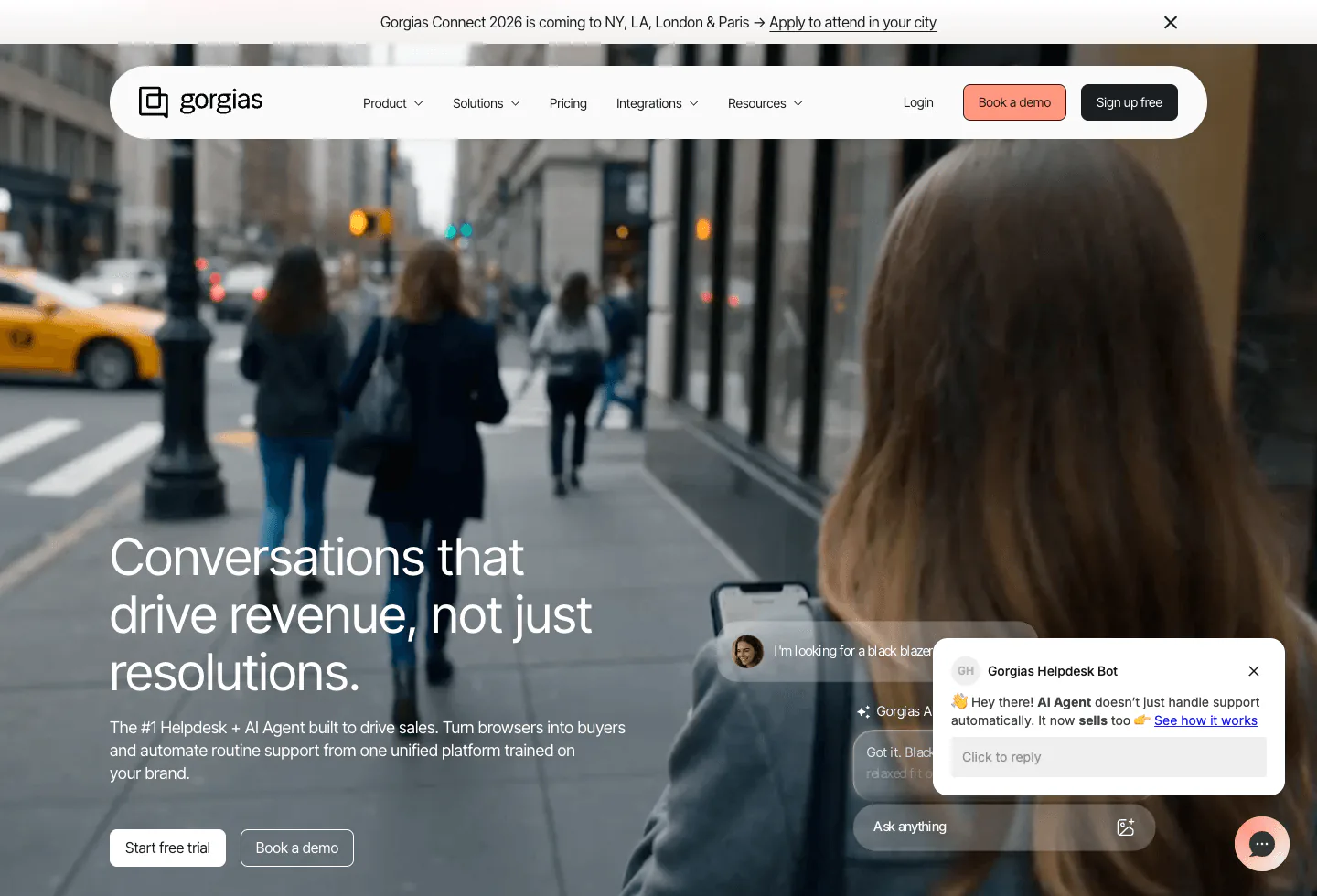 Official Gorgias product page
Source snapshot 2026-08-19 - gorgias.com
Positioning, Shopify-centric inbox, and Helpdesk plus AI Agent packaging checked on the vendor homepage.
Official Gorgias product page
Source snapshot 2026-08-19 - gorgias.com
Positioning, Shopify-centric inbox, and Helpdesk plus AI Agent packaging checked on the vendor homepage.
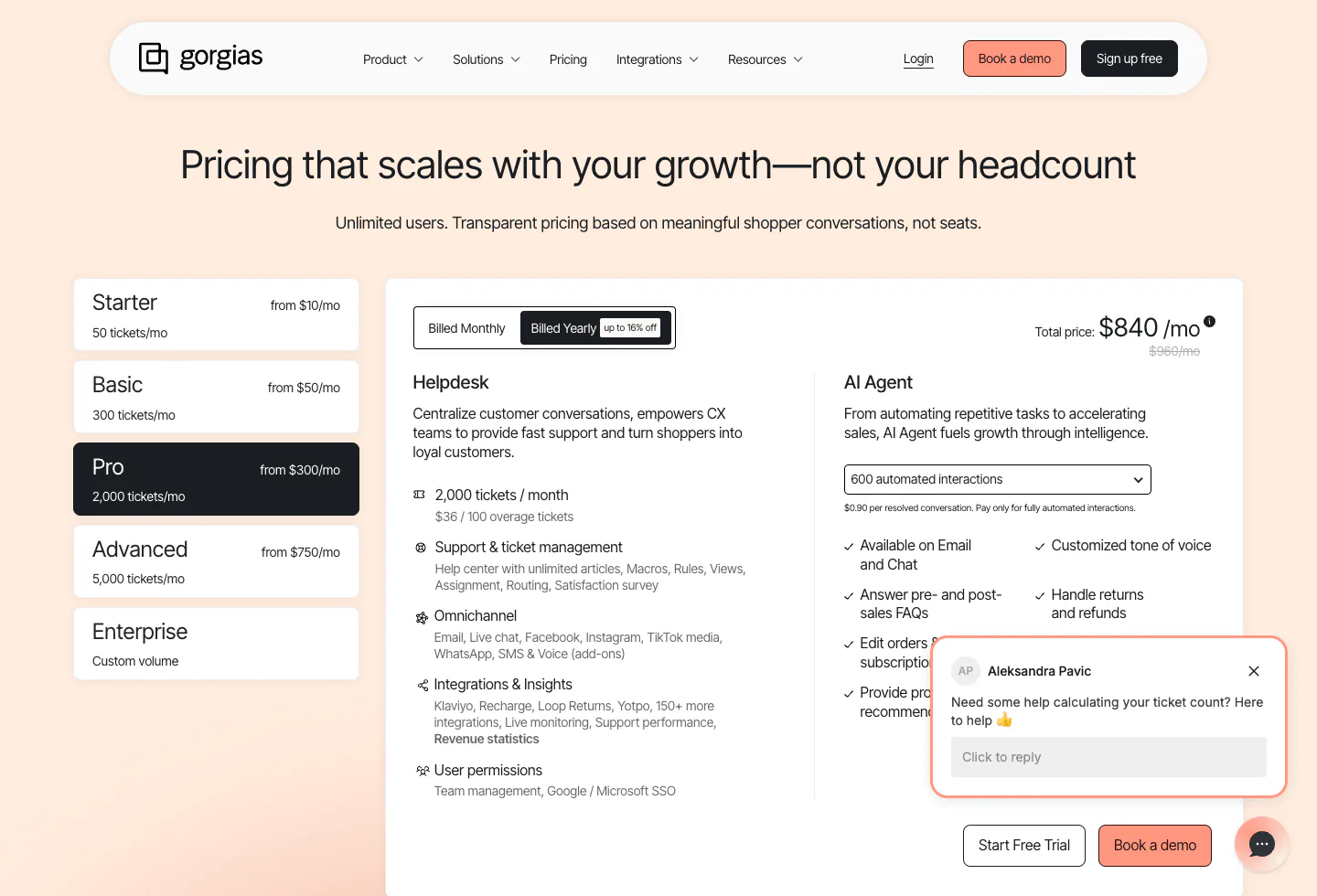 Official Gorgias pricing page
Source snapshot 2026-08-19 - gorgias.com
Helpdesk ticket ladder, AI Agent on-plan messaging, and Voice or SMS add-on framing.
Official Gorgias AI Agent pricing explainer
Source snapshot 2026-08-19 - gorgias.com
$0.90 and $1.00 resolved-interaction rates, included allotments, and overage bands.
Official Gorgias security page
Source snapshot 2026-08-19 - gorgias.com
SOC 2 Type II, HIPAA on request, SSO, 2FA, and Trust Center pointer.
Official Gorgias pricing page
Source snapshot 2026-08-19 - gorgias.com
Helpdesk ticket ladder, AI Agent on-plan messaging, and Voice or SMS add-on framing.
Official Gorgias AI Agent pricing explainer
Source snapshot 2026-08-19 - gorgias.com
$0.90 and $1.00 resolved-interaction rates, included allotments, and overage bands.
Official Gorgias security page
Source snapshot 2026-08-19 - gorgias.com
SOC 2 Type II, HIPAA on request, SSO, 2FA, and Trust Center pointer.
Claim and source ledger
What this profile is based on
Public Gorgias homepage, pricing page, AI Agent pricing explainer (updated May 28, 2026), plan guide (updated May 14, 2026), and security page, rechecked August 19, 2026. Helpdesk list prices, ticket allotments, overages, AI rates, and Voice from $70 per month come from those pages. Existing product and pricing screenshots in /images/sources/ are reused.
What we did not verify
We did not run a production Shopify connector, measure AI accuracy on a labeled WISMO set, time store sync lag, or review SOC 2 or HIPAA reports under NDA. We did not receive a custom Enterprise quote. The live pricing page is JavaScript-rendered. Some dollar figures on that page (for example an AI Agent card shown near $171 per month in crawls) did not map cleanly onto the blog tables. Treat in-account quotes as the contract, not this page.
How we scored fit
Editorial fit weights store-native context, the honesty of ticket-plus-AI billing at peak, Action depth with guardrails, and whether a non-retail team would get stranded. It is not a CSAT score, resolution-rate benchmark, or vendor rating.
Should you choose Gorgias?
Choose Gorgias when ecommerce support is the job and Shopify (or a sibling store platform) is the system of record. You get a ticket-priced inbox, unlimited seats from Pro up, and an AI Agent that can close tracking and return conversations with store data. You also get a second meter that can outrun the helpdesk sticker the first time you have a delayed-carrier week.
Best for DTC support teams that will own macros, refund caps, and weekly source hygiene. Skip it for B2B SaaS, for ITSM, and for stores that only need a website widget. Model a quiet month and a peak month with both meters before you compare it with Zendesk seats or Intercom outcomes. If that spreadsheet is ugly, the product is not “too expensive.” Your volume is simply larger than the sticker you were quoting.
FAQ
Common questions
What is Gorgias best used for?
As the support OS for an ecommerce brand: order data in the inbox, WISMO and returns automated, humans on exceptions. It is not a general-purpose AI agent for non-retail work.
Does Gorgias only work with Shopify?
No. Official pages list Shopify, BigCommerce, Magento, and WooCommerce. Shopify is the deepest. Verify Magento or WooCommerce Actions in a trial. Those connectors are not the same product.
How does Gorgias pricing work?
Helpdesk ticket allotments: $10/50, $60/300, $360/2,000, $900/5,000 on the May 2026 plan guide, overages $0.40 or $0.25. AI Agent about $0.90 per fully resolved bot conversation ($1.00 on Starter), with higher overage past the allotment. Annual save advertised up to 17% except Starter. Voice from $70/mo plus usage. Confirm on gorgias.com/pricing.
Does AI Agent count as a helpdesk ticket?
Not if the bot fully resolves it. That conversation moves to the AI meter. If a human takes over, it is a normal ticket. You should not be charged twice. Verify reopenings on a sample of your tickets.
How long does Gorgias take to set up?
Gorgias says most Shopify brands go live within 48 hours. Multi-store, subscription apps, ticket migration, and Voice take longer. The 7-day trial (10 email tickets, no Help Center publish) is too thin. Budget a 14-30 day paid pilot.
Is Gorgias secure enough for customer and order data?
Public claims include SOC 2 Type II, HIPAA on request, SSO, 2FA, and GCP hosting. Request Trust Center reports, limit refund Actions by role, keep cards out of chat, and review Shopify OAuth scopes like a new admin user.
Gorgias vs Zendesk AI for ecommerce: which should we buy?
Gorgias if store-native macros and ticket-based pricing matter more. Zendesk AI if you already run Zendesk or need sandbox, custom roles, and SLA clocks. Many retailers outgrow Gorgias governance before they outgrow its Shopify depth.
Gorgias vs Intercom Fin?
Gorgias is a commerce helpdesk. Fin is an outcome-priced agent on Intercom seats (or another desk). If agents live in Shopify tickets, Gorgias is shorter. If they live in Messenger, Fin is. Pick the inbox you will staff.
Who should skip Gorgias?
Skip it without product-order volume, if WhatsApp is the primary channel, if legal needs Zendesk-like SLA controls, or if nobody will maintain catalog sources. Skip Starter as a production plan: 50 tickets and 3 seats will not survive a launch.
What are the main drawbacks?
The dual meter is easy to under-model. Peak AI overages cost more than the included rate. Voice and SMS are extra. Governance is lighter than Zendesk. May 2026 AI packaging was described two ways, so quotes need to be in writing.
Also review