
What is agentic AI? A practical guide for business buyers
Agentic AI explained for business buyers in 2026: how it differs from chatbots, RPA, and GenAI assistants, plus a decision framework, governance checklist, and links to category tools.
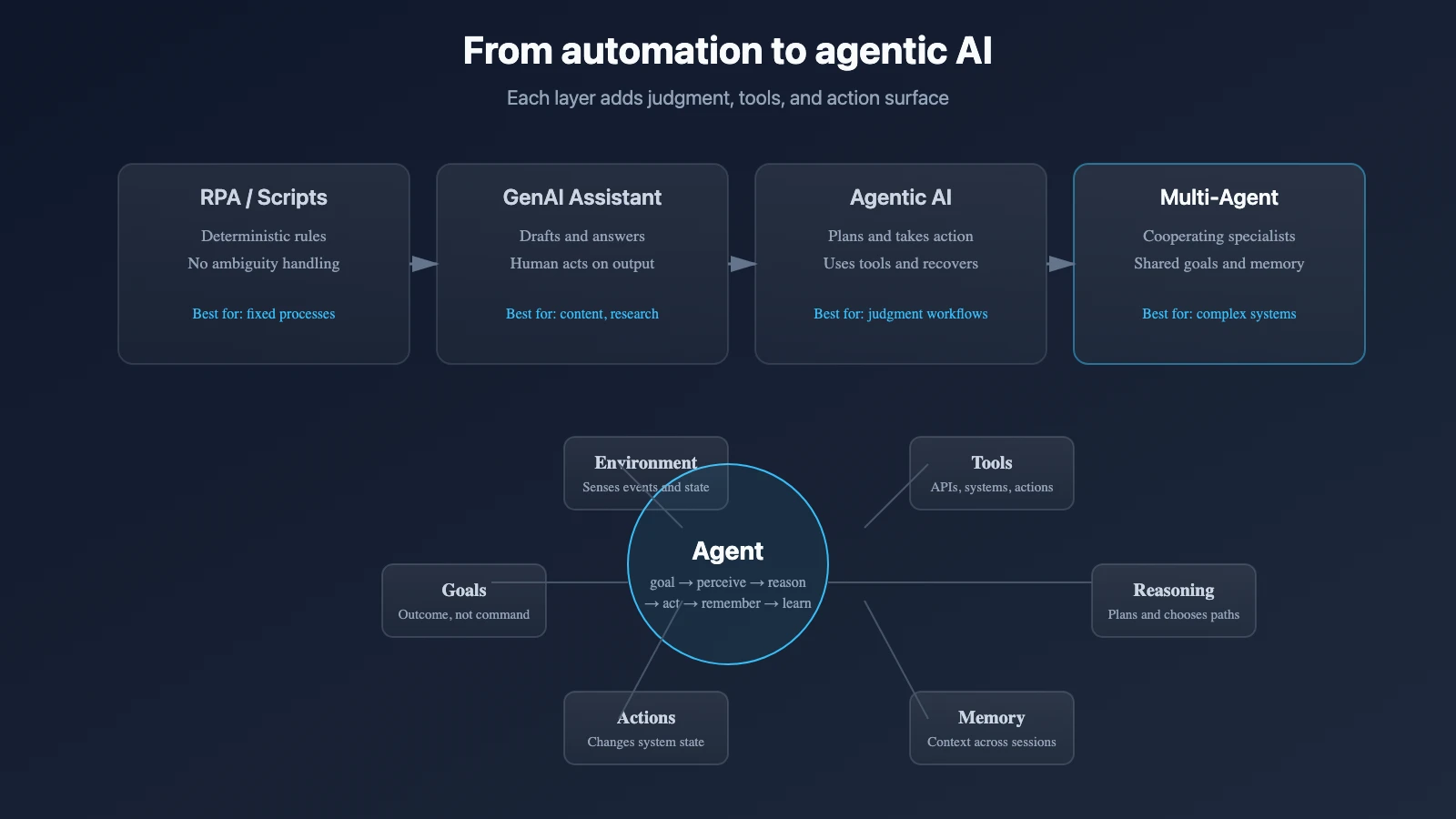
Agentic AI explained for business buyers in 2026: how it differs from chatbots, RPA, and GenAI assistants, plus a decision framework, governance checklist, and links to category tools.
Agentic AI is software that pursues a goal by sensing its environment, reasoning about the next step, and taking action through tools—instead of just answering a prompt. That distinction separates it from chatbots, content generators, and traditional automation. It is also why the 2026 buying conversation has shifted from “which model?” to “which workflow, with what controls?”
For related buyer guides, see best AI agent tools, AI workflow automation agents, AI agents for business, multi-agent systems explained, and agent vs automation.
A 2026 research conceptualization in Business & Information Systems Engineering proposes six capabilities that distinguish agentic AI from earlier automation and generative AI. Those capabilities are a useful buyer lens because they map directly to product evaluation questions.
| Capability | What it means for buyers | Test this in a demo |
|---|---|---|
| Goals | The agent is given an outcome, not just a command. | Ask it to handle a refund end-to-end, not only draft a reply. |
| Environment interaction | It reads events, tickets, emails, calendars, or market signals. | Show a real ticket arriving and watch how the agent notices it. |
| Tools | It can query systems, write records, send messages, or call APIs. | List exactly which systems it can touch and under what identity. |
| Reasoning | It breaks the goal into steps and chooses between paths. | Ask why it picked one action over another; look for traceability. |
| Memory | It remembers context across a session and, ideally, across sessions. | Start a task, interrupt it, and resume without re-explaining. |
| Actions | It changes system state, not only produces text. | Confirm it can issue a refund, create a case, or book a meeting. |
If a vendor cannot demonstrate all six on your real systems, you are buying an assistant, not an agent. That is not bad—assistants are valuable—but it changes the governance and pricing math.
The same research framework distinguishes two levels:
Salesforce calls this pattern multi-agent orchestration in its enterprise agentic architecture guide. The guide recommends starting with a single agent and moving to specialist agents only after the boundaries between responsibilities are clear. That advice is worth repeating: multi-agent architectures add resilience, but only if each agent has a narrow, testable scope.
| System | What it does | Best fit | Limitation |
|---|---|---|---|
| Chatbot | Matches intent, returns answers | FAQs, simple triage | No multi-step execution or recovery |
| RPA / scripts | Runs deterministic rules | Repetitive, stable processes | Breaks when the UI or rules change |
| GenAI assistant | Drafts, summarizes, answers | Content, research, coding help | Needs human to act on the output |
| Agentic AI | Plans and executes toward a goal | Workflows with judgment and recovery | Requires controls, observability, and data governance |
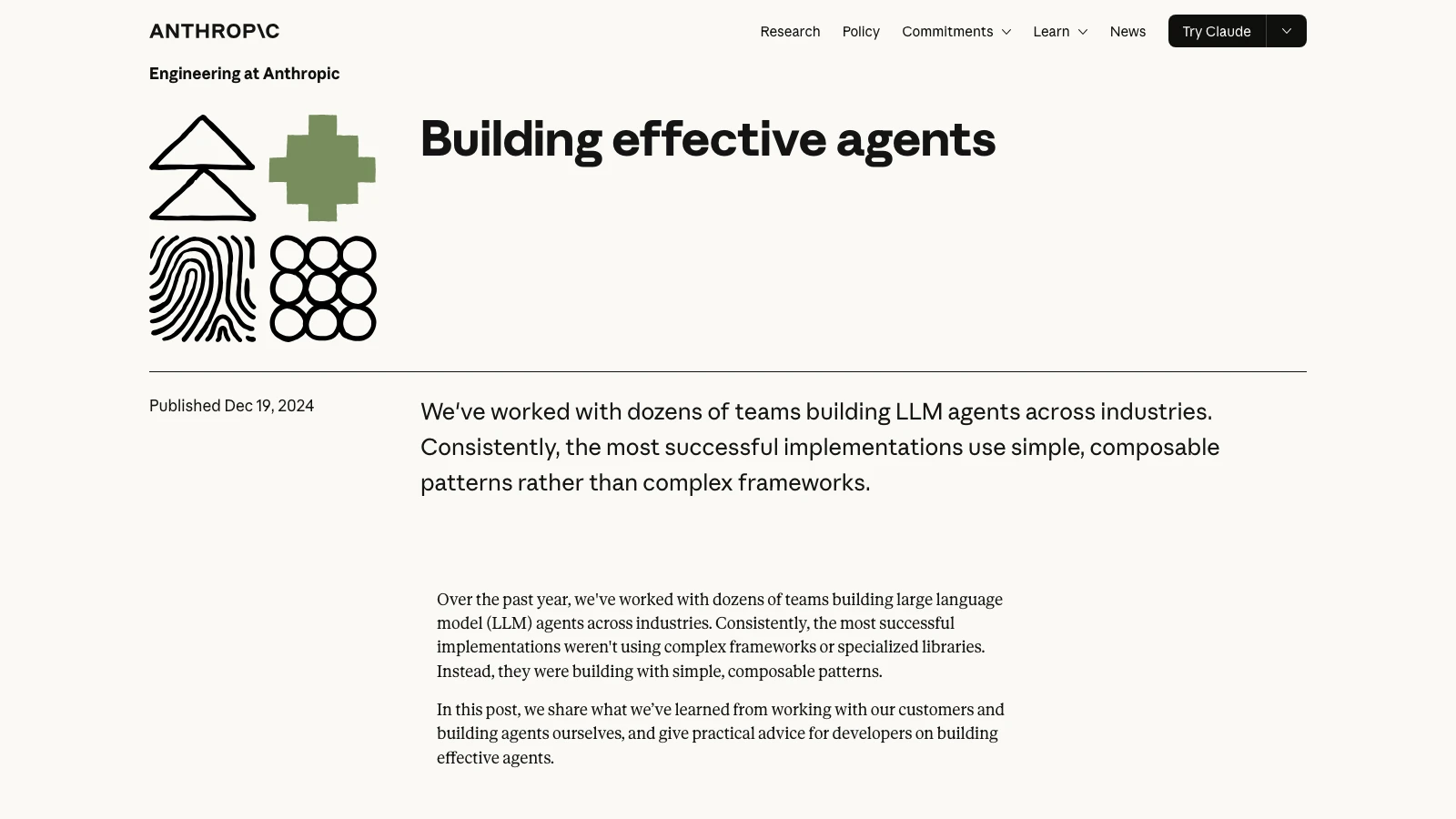
The Salesforce engineering blog on building enterprise AI agents captures the tension cleanly: enterprises need the flexibility of neural reasoning and the reliability of deterministic execution. Salesforce’s answer is “guided determinism,” where an Agent Graph enforces hard validation gates while the model handles subjective steps. Anthropic draws a similar line in its building effective agents guide: workflows are predefined orchestration, while agents dynamically direct their own process and tool use. Both sources agree that the right choice depends on how uncertain the path is.
The clearest fits are workflows that combine conversation, system access, and a recoverable plan:
Gartner predicts that 15% of day-to-day work decisions will be made autonomously through agentic AI by 2028, up from effectively 0% in 2024. The same press release warns that over 40% of agentic AI projects may be canceled by end of 2027 due to unclear value, escalating cost, or inadequate risk controls. The practical takeaway: agentic AI is real, but so is the failure rate when teams skip governance.
Skip agents when the path is fixed, the cost of a wrong action is high, or the data foundation is weak:
Use these five questions before signing a contract:
Agentic AI inherits LLM risks—hallucination, bias, prompt injection—and adds new ones through tool access. A minimal governance layer should cover:
A safe pilot follows a narrow path:
Buyer conversations often stall because “agentic AI” is used to describe everything from a slightly smarter chatbot to a fully autonomous system. The major platforms now occupy distinct layers, and the right choice depends on which layer you need to own.
| Platform layer | What it gives you | Typical buyers | Caveat |
|---|---|---|---|
| Foundation model + API | Raw reasoning and tool-use capability | Teams building their own harness | You still have to build orchestration, memory, and guardrails |
| Agent SDK / framework | Reusable loops, tool calling, tracing | Engineering teams with agent ops capacity | LangGraph, CrewAI, AutoGen, OpenAI Agents SDK, Google ADK, Anthropic Agent SDK each make different trade-offs |
| Hosted agent platform | Managed runtime, connectors, governance UI | Business teams without dedicated agent infra | Vendors include Salesforce Agentforce, HubSpot Breeze, Microsoft Copilot Studio, ServiceNow AI agents |
| Vertical agent application | Pre-built agents for one domain | Teams that want a narrow, opinionated workflow | Customer-service agents, coding agents, SDR agents, finance agents |
Salesforce Agentforce is the deepest enterprise option for teams already on Sales Cloud. It can reuse existing custom objects, Flows, and Apex, which lowers the data-modeling burden—but the Flex Credit model means real cost scales with actions, not seats. The Agentforce sales demo shows prospect prioritization, automated outreach, meeting prep, and follow-up drafting inside Salesforce.

Anthropic, by contrast, emphasizes simplicity. Its building effective agents guidance argues that most production systems should start as workflows and only promote to agents when the path is genuinely uncertain. The Claude Agent SDK and Managed Agents give developers a harness, but Anthropic’s core message is that the framework matters less than the infrastructure around it.
Most practitioners use the terms interchangeably. Strictly, “agentic AI” refers to systems that exhibit agentic capabilities, while an “AI agent” is one instance of such a system. A multi-agent system is agentic AI made of several cooperating agents.
Not necessarily. The model needs strong reasoning and tool-use reliability, but the bigger differentiator is the harness around it: orchestration, memory, tools, guardrails, and observability.
No. It can handle repetitive judgment work, but humans remain responsible for setting goals, defining policies, approving high-risk actions, and reviewing edge cases.
RPA follows hardcoded steps. Agentic AI reasons about steps and can adapt when the situation changes. RPA is faster and more predictable for fixed tasks; agents are more flexible for ambiguous tasks.
Buying autonomy before buying controls. An agent with broad tool access and weak governance becomes a liability faster than it becomes a productivity gain.
If agentic AI is on your roadmap, start with architecture, not vendor demos. Read our multi-agent systems explained guide for orchestration patterns, AI workflow automation agents for the product layer, and agent vs automation for the decision test that prevents overbuilding. Then run a bounded pilot with real tools, real data, and a real human checkpoint before expanding.
Further reading
4 next jobs from this page. Named destinations, not a pile of related guides.
04