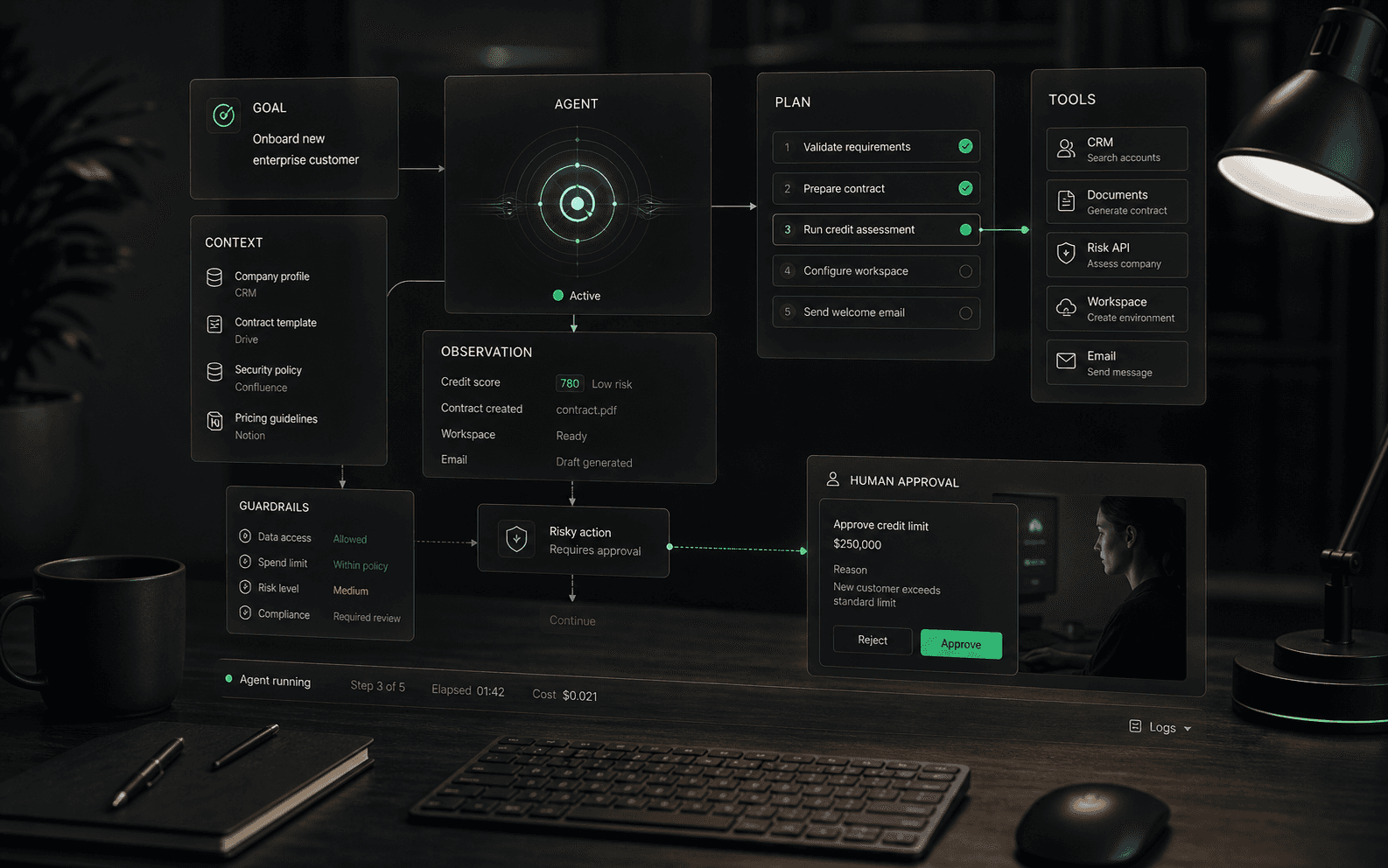
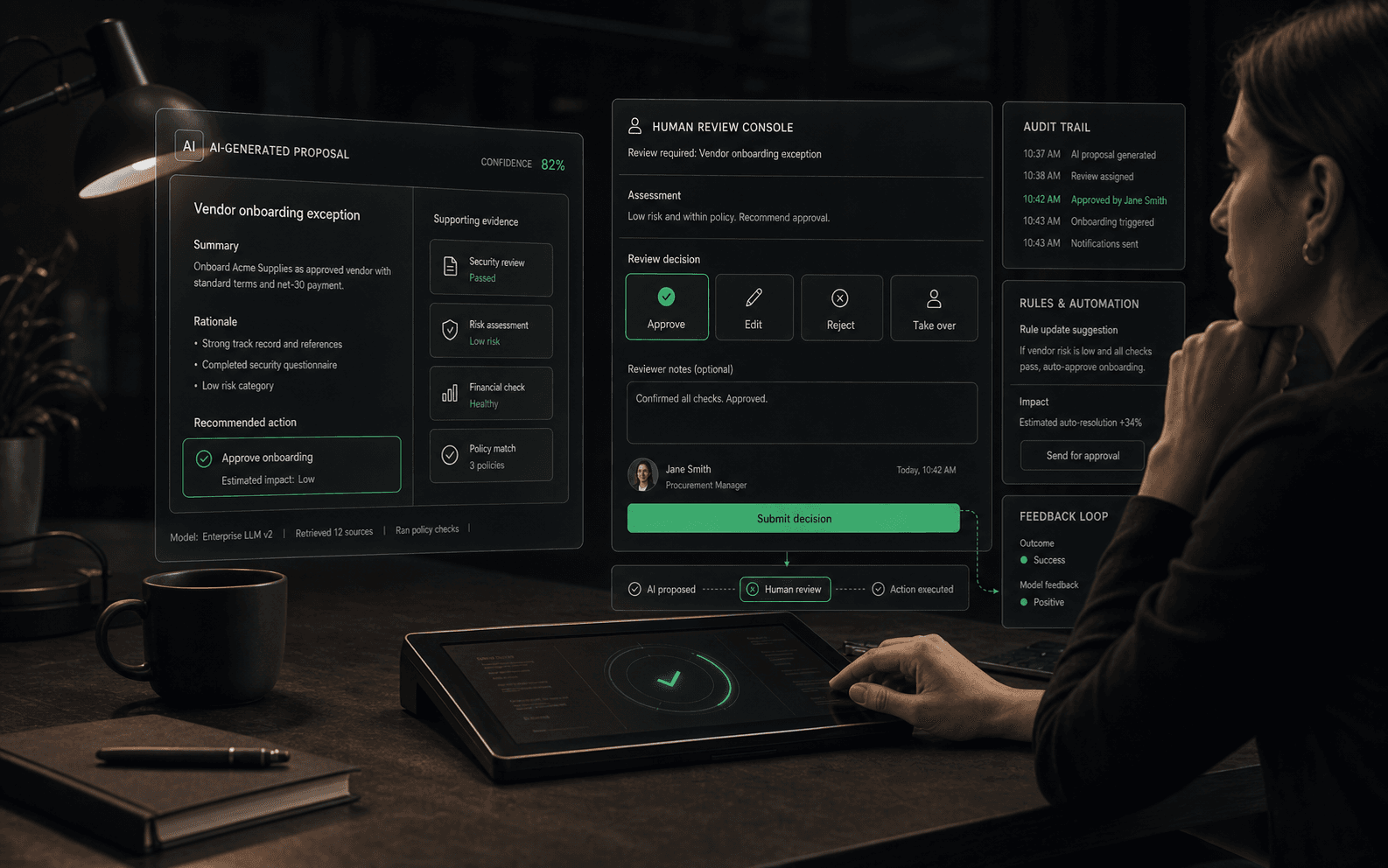
What it means operationally
Human in the loop is a control pattern, not a vague reassurance. It defines where people stay involved in an AI workflow: before a response is sent, before an action is executed, when confidence is low, when a customer is upset, when policy risk appears, or when the agent reaches a task it is not allowed to complete.
How human-in-the-loop actually works
- Trigger: the workflow reaches a condition that requires human judgment, such as low confidence, high value, sensitive content, restricted action, angry customer language, or missing context.
- Package: the system sends the reviewer enough context to decide: conversation history, retrieved sources, customer record, proposed answer, proposed action, and reason for escalation.
- Decision: the human approves, edits, rejects, reassigns, asks for more information, or takes over the conversation.
- Record: the system logs the agent proposal, human change, final decision, timestamp, and owner.
- Improve: teams review patterns in overrides and missed escalations to update sources, prompts, workflow rules, permissions, or reviewer training.
Common control models
- Review before send: the agent drafts a response, but a person approves or edits it before the customer sees it.
- Approval before action: the agent prepares an account update, refund, cancellation, or workflow step, but a person must approve execution.
- Exception routing: the agent handles routine cases but escalates low-confidence, sensitive, angry, or high-value interactions.
- Supervisor takeover: a person can enter the conversation or workflow with context preserved.
- Post-action audit: teams review completed conversations and actions to identify quality issues, but this is weaker than real-time control for risky workflows.
Human in the loop versus human on the loop
Human in the loop usually means a person is part of the decision path before an important outcome is completed. Human on the loop usually means a person monitors the system and can intervene, but the system may continue acting unless the person stops it. Buyers should ask which model a vendor means. For a refund, account change, or sensitive support answer, monitoring after the fact may not be enough.
Where it matters most
Human control matters most when the cost of a wrong answer is high. That includes refunds, billing disputes, account access, medical or legal-adjacent questions, contract terms, angry customers, VIP accounts, regulated language, irreversible actions, and any workflow where the agent could expose private data or make a customer-impacting change.
Concrete examples and non-examples
- Example: an agent drafts a refund recommendation, but a support lead must approve it before money is returned or account records change.
- Example: a customer asks for legal, medical, or contract-specific guidance, and the agent routes the conversation to a trained teammate instead of producing a confident answer.
- Example: a reviewer sees the retrieved sources, proposed response, previous conversation, and suggested next action before approving a customer-facing message.
- Non-example: a transcript is stored after the conversation ends, but no person can intervene before the answer or action reaches the customer.
- Non-example: a live chat transfer button exists, but the human receives no summary, source trail, attempted steps, or reason for escalation.
What buyers should verify
- Which events trigger human review, and can the business configure those triggers?
- Can reviewers edit, approve, reject, reassign, or take over, or can they only view a transcript?
- Does the handoff include customer context, source references, attempted steps, and the reason for escalation?
- Are approvals recorded with user, timestamp, changed content, and final action?
- Can different teams apply different review rules by workflow, channel, risk level, or customer segment?
- What happens to customer experience while the workflow waits for a person?
Demo tests for oversight quality
- Ask the agent to complete a sensitive action and confirm the approval gate appears before the action executes.
- Create an angry customer scenario and inspect what context the human receives during escalation.
- Ask for a reviewer to edit an agent answer and verify that the final audit trail shows the change.
- Delay reviewer response and see what the customer experiences while waiting.
- Review analytics for missed escalations, false escalations, reviewer load, and override patterns.
Tradeoffs to plan for
Human in the loop reduces risk but does not remove operational work. Review queues need staffing, prioritization, service-level expectations, and escalation ownership. If every conversation requires approval, automation may become slower than the original process. If almost nothing requires approval, the system may create risk under the appearance of control.
Queue design matters
A human review queue should not be a single pile of exceptions. It needs priority levels, ownership rules, routing by expertise, service-level expectations, and a way to distinguish customer urgency from internal QA. A billing dispute, security concern, VIP account, routine product question, and content-quality review should not compete blindly for the same reviewer attention.
Red flags
Be cautious when a vendor uses human in the loop to mean only a generic live chat transfer, a transcript after the fact, or a support inbox notification with no approval controls. The phrase should map to specific product behavior: trigger rules, reviewer actions, permissions, audit logs, and a clear customer experience during handoff.
Metrics to monitor
Useful metrics include review queue volume, average approval time, human override rate, missed escalation rate, false escalation rate, customer wait time during review, percentage of sensitive actions approved by role, and the number of incidents found during post-resolution QA. These metrics help reveal whether oversight is improving quality or simply adding friction.
Escalation design
Good human-in-the-loop design defines who receives the escalation, what context they see, what decision they can make, and what the customer experiences while waiting. It should also define priority rules: a refund approval, a security concern, a billing complaint, and a routine product question should not sit in the same undifferentiated queue. The goal is not to add a person everywhere; it is to place human judgment where it changes the outcome.
Ownership after launch
Human review needs an owner. Someone has to tune escalation rules, inspect overrides, train reviewers, manage queue load, and decide when an agent can move from mandatory review to sampled QA. Without ownership, teams often drift into two bad patterns: approving everything because the queue is overloaded, or escalating everything because nobody trusts the automation.
Sources to verify
Use these references to understand the term and pressure-test vendor claims. Product-specific details still need to be verified against current vendor materials.
FAQ
Common questions
Is human in the loop the same as human handoff?
Not exactly. Handoff usually means transferring a conversation to a person. Human in the loop can also include approval gates, review queues, exception handling, and human control before an automated action is completed.
Does human in the loop make an AI agent safe?
It helps manage risk, but it is not a complete safety system. Buyers should still evaluate permissions, testing, audit logs, fallback behavior, and how often human review is actually triggered.
When should human review be mandatory?
Mandatory review is most useful for irreversible actions, sensitive customer issues, account changes, refunds, billing disputes, low-confidence answers, and workflows where policy or compliance risk is meaningful.
What is the difference between human in the loop and human on the loop?
Human in the loop usually means a person is part of the decision path before a response or action is completed. Human on the loop usually means a person monitors the system and can intervene, but the system may continue unless stopped. For sensitive workflows, buyers should ask whether humans can change the outcome before it reaches the customer or system of record.
What should a human reviewer see before approving an AI agent action?
A reviewer should see the conversation history, customer or account context, retrieved sources, the agent's proposed response or action, the reason the case was escalated, and any relevant risk flags. If the reviewer only sees a transcript with no source trail or proposed action, approval can become guesswork rather than meaningful oversight.
Can human in the loop slow down support?
Yes. Human review can create queues, delays, and staffing requirements if every low-risk case needs approval. The goal is to place review where judgment changes the outcome: sensitive actions, low-confidence answers, VIP customers, angry customers, billing disputes, or irreversible changes. Good queue design keeps routine work moving while protecting high-risk cases.
How do you measure human-in-the-loop quality?
Useful measures include review queue volume, average approval time, override rate, missed escalation rate, false escalation rate, customer wait time, reviewer agreement, incidents found in QA, and how often review feedback improves prompts, sources, or workflow rules. These metrics show whether oversight is improving outcomes or only adding friction.
What are common human-in-the-loop failure modes?
Common failures include rubber-stamp approvals, overloaded review queues, unclear ownership, reviewers without enough context, escalation rules that are too broad or too narrow, and post-action logging presented as real-time control. Buyers should test the review path with realistic edge cases before trusting it in production.
Who should own human-in-the-loop workflows?
Ownership usually needs to be shared. Operations or support leaders should own workflow quality and review rules, while IT or security teams own permissions, logging, and system access. The key is naming who can change escalation thresholds, pause automation, train reviewers, and decide when a workflow moves from mandatory approval to sampled QA.